
A well-placed mirror in the entryway does more than help someone check their appearance before heading out. It amplifies light, expands the perceived space, and sets the design tone for the entire home. Modern entryway mirrors go beyond basic function, they’re architectural elements that can anchor a narrow hallway, balance an asymmetric wall, or become the focal point visitors remember. Whether mounting a single oversized piece or arranging a multi-panel composition, choosing the right mirror involves understanding scale, shape, and how the reflection interacts with available light sources.
Table of Contents
ToggleKey Takeaways
- Modern entryway mirrors amplify light, expand perceived space, and set the design tone for your entire home while serving as functional architectural elements.
- Strategic mirror placement—such as positioning opposite windows or perpendicular to the entrance—maximizes natural light and creates the illusion of added square footage in narrow hallways.
- Oversized statement mirrors (60+ inches tall) require proper wall anchoring into studs or heavy-duty fasteners to safely support their weight with a 50% safety margin.
- Frameless and floating mirror designs with beveled edges or LED backlighting create clean, contemporary aesthetics ideal for minimalist and Scandinavian-inspired entryways.
- Geometric and asymmetrical mirror shapes—like hexagons, circles, and irregular forms—function as sculptural focal points that add visual interest without occupying floor space.
- Multi-panel grid arrangements and clustered mirror compositions allow flexible, phased installation and work best when started from the center and expanded outward to maintain symmetry.
Why Your Entryway Needs a Modern Mirror
Most entryways suffer from two problems: limited natural light and narrow footprints. A strategically placed mirror addresses both by bouncing light from windows or fixtures deeper into the space and creating the illusion of added square footage.
From a practical standpoint, an entryway mirror provides a last-minute checkpoint before leaving, catching stray hairs, checking outfit proportions, or spotting forgotten items. But the real value lies in how it transforms the room’s spatial dynamics.
Placement matters. Mounting a mirror opposite a window doubles the natural light hitting the space. Positioning it perpendicular to the entrance creates visual depth, making a cramped hallway feel gallery-like. Avoid placing mirrors directly facing the front door, this can create disorienting reflections for anyone entering and may violate some feng shui principles, though that’s more aesthetic preference than structural concern.
Modern mirror designs also introduce texture and geometry that flat walls lack. A sculptural frame, an irregular edge, or a metallic finish adds visual interest without occupying floor space, critical in tight entryways where bulky furniture overwhelms the area.
Oversized Statement Mirrors for Dramatic Impact
Floor-to-ceiling or wall-spanning mirrors make small entryways feel like architectural features rather than afterthought corridors. These pieces typically measure 60 inches tall or larger and work best on uninterrupted wall sections.
Installation considerations: Mirrors over 50 pounds require proper wall anchoring. Locate studs with a stud finder and use heavy-duty wall anchors rated for the mirror’s weight plus a 50% safety margin. For drywall without stud backing, toggle bolts or molly bolts distribute weight across a larger surface area. Plaster walls may need specialized anchors to prevent cracking.
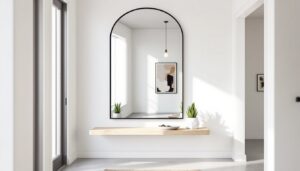
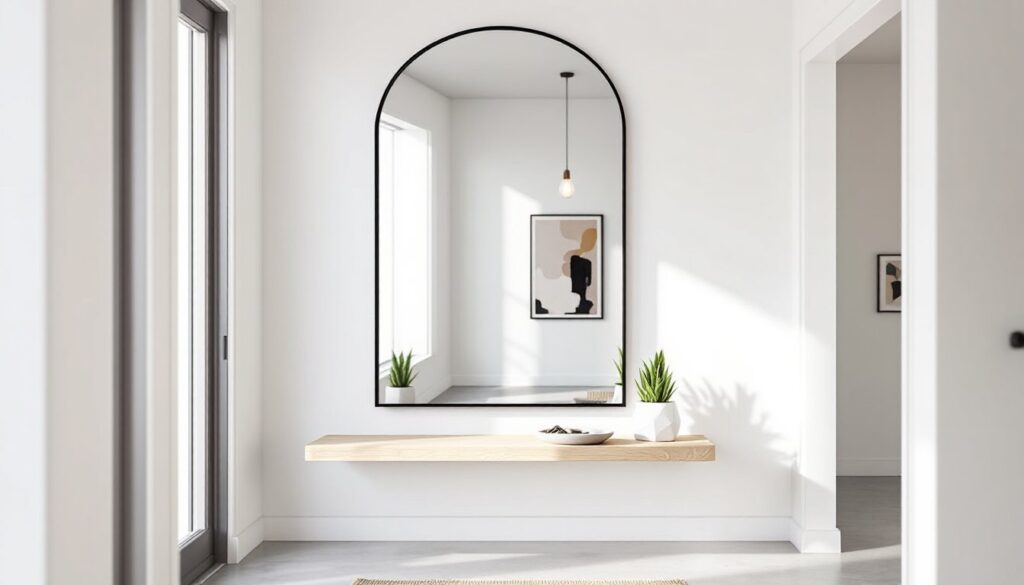
Oversized mirrors with thin metal frames, brass, matte black, or brushed nickel, complement modern interiors without competing with other design elements. The frame acts as a subtle outline rather than a decorative border. Some designs incorporate arched tops, a 2020s trend that’s gaining traction in modern interior design circles for softening angular spaces.
Leaning mirrors offer an alternative to wall-mounting. A full-length mirror leaned against the wall at a slight angle creates a casual, gallery-like aesthetic. Secure the top edge with L-brackets or museum putty to prevent tipping, especially important in homes with children or pets. This method also avoids drilling into tile or brick, common materials in entryway accent walls.
Safety note: Tempered glass is essential for mirrors this size. If the mirror shatters, tempered glass breaks into small, blunt pieces rather than sharp shards. Most quality manufacturers specify this in product descriptions.
Minimalist Frameless and Floating Mirror Designs
Frameless mirrors create clean, uninterrupted reflections that suit contemporary and Scandinavian-inspired entryways. These designs rely on polished or beveled edges rather than frames to define their perimeter.
Beveled edges, typically cut at a 1-inch angle, catch and refract light, adding subtle dimension without ornamental framing. The bevel also reduces the risk of chipping during installation or cleaning. Frameless mirrors work particularly well in monochromatic entryways where a bold frame would introduce unwanted visual noise.
Floating mirrors use stand-off mounts or French cleats to create a 0.5- to 2-inch gap between the mirror and wall. This shadow gap amplifies the illusion of depth and allows for optional LED backlighting. LED tape lights (2700K to 3000K color temperature recommended for warm, welcoming light) can be adhered to the wall behind the mirror, creating a soft halo effect.
Installation tip: Use a laser level to mark horizontal and vertical reference lines before mounting. Even a 1-degree tilt becomes obvious in a frameless design due to the lack of visual distractions. For mirrors under 30 pounds, adhesive mirror mounts (like 3M’s Command strips rated for mirrors) work on smooth, painted walls. Anything heavier requires mechanical fasteners.
Frameless mirrors also pair well with floating console tables or wall-mounted shelves, maintaining an open, airy aesthetic that doesn’t crowd narrow entryways.
Geometric and Asymmetrical Mirror Shapes
Hexagons, irregular polygons, and asymmetric shapes disrupt the expected rectangle-and-square grid most rooms default to. These designs function as sculptural art pieces that happen to reflect.
Hexagonal mirrors typically measure 24 to 36 inches across and mount individually or in honeycomb clusters. The six-sided shape introduces visual rhythm without the formality of traditional frames. Brass or black metal trim around each edge defines the geometry while keeping the look streamlined.
Asymmetrical mirrors, freeform shapes with no repeating pattern, serve as focal points in otherwise minimal entryways. These work best as solo pieces rather than part of a grouping. Expect to pay more for custom or irregular shapes due to the specialized cutting required.
Circular and pill-shaped mirrors have become staples in modern design, softening the hard angles common in contemporary architecture. A 30- to 40-inch diameter circle provides adequate reflection surface without overwhelming a 6- to 8-foot entryway wall.
When selecting geometric mirrors, consider how the shape interacts with existing architectural features. A hexagon complements coffered ceilings or patterned tile floors. An asymmetric mirror balances a gallery wall of framed photos or artwork on an adjacent wall. Many home design ideas emphasize shape contrast as a way to add visual interest without clutter.
Mounting irregular shapes requires extra attention to balance. The mirror’s center of gravity may not align with its visual center, so use a helper or temporary adhesive putty to test placement before drilling final anchor points.
Multi-Panel and Cluster Mirror Arrangements
Grid-style mirror panels or curated clusters transform a blank wall into a dynamic focal point. These arrangements work particularly well in entryways with high ceilings or wide wall sections that would dwarf a single mirror.
Grid panels typically use identical square or rectangular mirrors (12×12 inches or 16×16 inches are common sizes) arranged in 3×3, 4×4, or 2×6 configurations. The gaps between panels, usually 0.5 to 1 inch, create a subtle frame effect without heavy molding. This approach also allows for phased installation: homeowners can start with a 2×2 grid and expand as budget allows.
Installation requires careful layout. Use a chalk line or painter’s tape to mark the outer perimeter and interior grid lines. Start mounting from the center panel and work outward to ensure symmetry. Adhesive mirror mounts work for lightweight panels, but mechanical fasteners provide long-term security, especially in high-humidity entryways where adhesive may fail over time.
Clustered arrangements mix different shapes and sizes, a large circular mirror surrounded by smaller hexagons, or a trio of vertical rectangles staggered at varying heights. This style suits eclectic or transitional interiors where strict symmetry feels too rigid.
When planning clusters, lay out the arrangement on the floor first. Take a photo from above to visualize spacing and balance before committing to wall anchors. Aim for 2 to 4 inches of space between individual mirrors to prevent visual clutter.
Clusters also offer flexibility for modern living spaces where design preferences evolve. Individual mirrors can be rearranged or replaced without overhauling the entire installation.
Mirrors With Integrated Storage and Functionality
Combining a mirror with storage maximizes utility in compact entryways. Medicine cabinet-style designs, floating shelves with mirrored backs, and mirrored cabinet doors all serve dual purposes.
Mirror cabinets typically feature a shallow storage compartment (4 to 6 inches deep) behind the mirrored door, ideal for keys, sunglasses, pet leashes, or mail. Surface-mount cabinets install directly over drywall, while recessed versions require cutting into the wall between studs, a more involved project that may need a permit if modifying load-bearing walls or concealing electrical.
For surface-mount installations, locate at least two studs to anchor the cabinet securely. Use 3-inch wood screws driven into studs at the cabinet’s top mounting rail. If studs don’t align with the cabinet width, install a horizontal ledger board across multiple studs, then mount the cabinet to the ledger.
Mirrors with integrated hooks or shelves eliminate the need for separate hardware. Designs featuring a lower shelf (6 to 12 inches deep) provide a drop zone for everyday items, while upper hooks accommodate coats or bags. These combo units typically mount with a French cleat, a beveled mounting system that distributes weight evenly and allows for minor adjustments during installation.
Mirrored coat racks merge reflection and function by embedding hooks directly into or around a mirrored panel. Look for designs where hooks are welded or bolted to a structural frame rather than adhesive-mounted to the mirror itself, which can fail under load.
Safety reminder: Any mirror with storage should be anchored to studs, not just drywall. The combined weight of the unit plus stored items can exceed 75 pounds, well beyond the capacity of standard drywall anchors.
Conclusion
Modern entryway mirrors solve functional problems while elevating design. Whether opting for an oversized statement piece, a frameless floating design, geometric shapes, multi-panel grids, or storage-integrated options, the key factors remain the same: proper anchoring for the mirror’s weight, placement that maximizes light reflection, and scale appropriate to the wall and room dimensions. With careful planning and secure installation, the right mirror transforms a basic entryway into a well-lit, visually expanded space that sets the tone for the rest of the home.